
MUVAR KOIL - KODUMBALUR

MUVAR KOIL - KODUMBALUR 


MUVAR KOVIL or the threesome Temple of Lingams. With surviving two vimanas. Built during the period of PARANTAKA CHOLA II (957 - 970 CE. Three shrines with a Vimana Ardhamandapam & Mukhamandapam with Nandi.


Boothi Vikramakesari was a Velir Irukkuvel chieftain and a vassal of the medieval Cholas. He is endowed  with the building of these temples with three shrines known as Muvar Koil or the " Temple for three".

In the district of Pudukkottai - Tamilnadu.


MUVAR KOVIL.

MUVAR KOVIL or the threesom Temple of Lingams built during the period of PARANTAKA CHOLA II (957 - 970 CE).
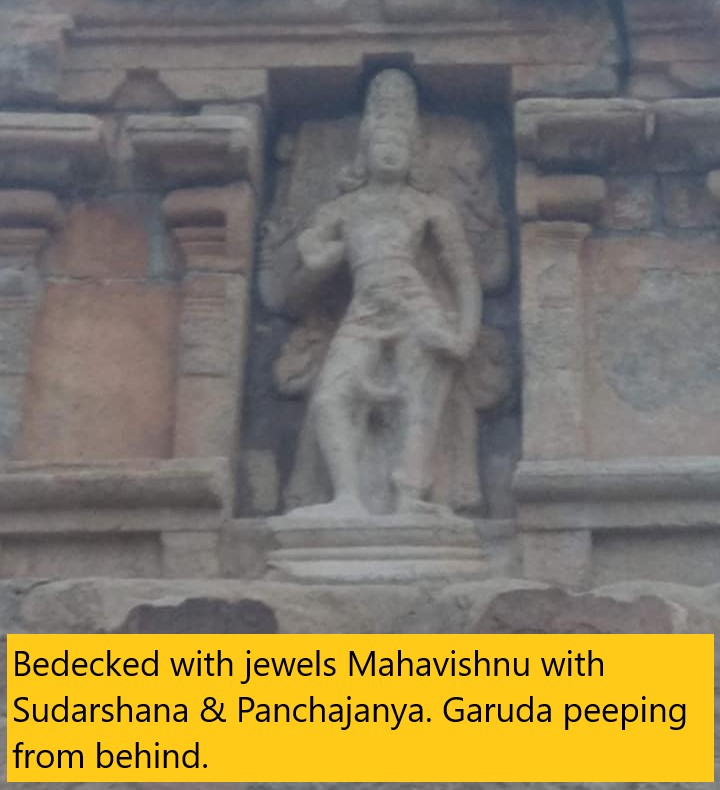
1. Mahavishnu

2. Veenadhara Shiva


3. Thandavamurthy


4. Gajasamharamurthy


5. Vrishabhantika & Gangadhara.


6. Eroded unique Shiva Icon


7. Sukhasanamurthy standing.


8. Thandavamurthy.


9. Thandavamurthy.


10. Sukhasanamurthy sitting.


Comments

Popular posts from this blog

KAILASANATHAR TEMPLE PART 1 - TARAMANGALAM

SRI KAILASANATHAR TEMPLE- TARAMANGALAM - SALEM DISTRICT - TAMILNADU.- PART 1 Seven tiered Rajagopuram Shaped like a chariot. Mahavishnu gave his sister Parvathi in marriage to Shiva. This process of handing over the bride, is known as "Thaaram vaththu koduppadhu" in Tamil, hence the name of the town THARAI MANGALAM now known as Tharamangalam. MAHAVISHNU giving his sister MEENAKSHI in marriage to SHIVA. In the centre of this Town is an exotic Temple of Lord Shiva as Shri Kailasanathar with his consort Sivakami Devi. One of the rarest of temples with a treasure of exotic Sculpture and the many stories attached with them. ONE OF THE MOST BEAUTIFUL U NKNOWN TEMPLES IN TAMILNADU. The first precinct on entering from the Rajagopuram. The temple had an existence before the 10th Century CE. However the same was rebuilt by the Getti Muthaliar Clan who ruled the Kongu Part of Tamilnadu from the 13th to the 17th century. The temple seems to have b...

KAILASANATHAR TEMPLE PART 2 - SHIVA - THE SUNDARA - TARAMANGALAM

SRI KAILASANATHAR TEMPLE - TARAMANGALAM - SALEM DISTRICT - TAMILNADU - PART 2. MADANIKA at the entrance  In the Kailasanathar Temple,there are 3 precincts in this temple, the open outer precinct and the inner precinct in the form of the Mukhamandapam, leading to the Garbhagriha.At the left of the entrance to the Mukhamandapam a Mummudi or 3 Vinayaka statues are at the left side of entrance. In to the Mukhamandapam you come to a treasure of Art Gallore. Lord Shiva as Kailasanatha, Sits in the form of a Small Lingam Facing West with the Avudayar or Pindika to the right of the lord in the Garbha Griha post an Ardhamandapam. Opposite facing the Lord, a little towards his right Side is his consort Goddess Parvathi standing in the form of Sivagami Devi. Towards the left opposite of the lord, is the sanctum of Karthikeya with Six faces. All these three sanctums including that of the lord is in a Trikona (Triangle) shape. On circumambulation, the oute...

ELEPHANTA CAVES PART 10 - SHIVA as LINGA – The SAGUNA form of NIRGUNA - GHARAPURI

GHARAPURI  - ELEPHANTA CAVES 10 SHIVA as LINGA – The SAGUNA form of NIRGUNA. Symbolic form of SHIVA – SHAKTHI. DWARAPALAKAS to the shirne of MAHADEVA Saguna  means “with attributes.”  Nirguna  means “without attributes.” “ Saguna ” describes a God with (tangible) attributes. The term “ Nirguna  Brahman” describes a God with no (tangible) attributes (source). The most popular form of worshipping Lord Shiva in Hinduism is in the LINGA form. It is known as SHIVALING or SHIVALINGA. The LINGA symbol is an attempt to give form to the formless, referred as Supreme Being or Brahman in Hindu religion. When a LINGA is installed on a YONI, it represents the union of SHIVA and SHAKTI – the beginning of creation. It is found at the centre of the temple, often resting in the middle of a rimmed, disc-shaped YONI. SHIVA as a LINGAM In the main cave, in the right middle six steps lead to a raised platform of 3.5 feet high. A cu...